
Cryptography developed at MERI for civilian drones
Global Navigation Satellite System (GLONASS) and the Element Group of Companies (Element) have introduced an identifier for civilian air drones…
15.07.2026
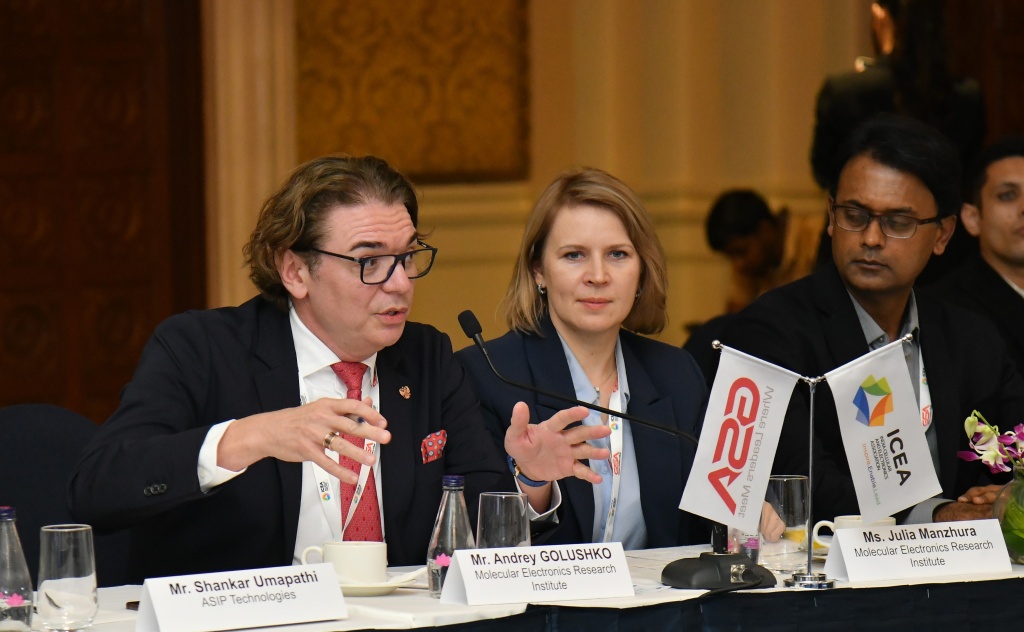
The delegation of Molecular Electronics Research Institute (part of the Element Group of Companies, MOEX: ELMT) participated in the India Semiconductor Leadership Roundtable conference dedicated to the development of the microelectronics industry in India. Representatives of the largest international and Indian companies as well as Indian government organizations attended it. The Global Semiconductor Alliance (GSA) and the India Cellular and Electronics Association (ICEA) in Bangalore, India organized the event. The partner was Tata Electronics.
India aims to create its own semiconductor ecosystem capable of integrating into global supply chains.
The conference was dedicated to synchronizing Indian programs with global technological trends and identifying practical ways for cooperation among stakeholders. The participants discussed topics related to the development of the global market, measures of state support, sustainable models of cross-border cooperation, technology transfer, and personnel training.
The Deputy General Director of MERI Andrey Golushko emphasized that the country's technological sovereignty is unattainable without domestic microelectronic technologies. He spoke about the Russian and Soviet experience in the development of microelectronics, the achievements of Russian microelectronics, and the tasks that MERI is addressing. Andrey Golushko noted the deep traditions of cooperation between Russia and India in the field of science and technology. Cooperation programs united scientific groups in academic institutions, employees of industrial enterprises, teachers, and students in educational institutions. Currently, both countries are making coordinated efforts to strengthen and expand cooperation. The implementation of scientific ideas, the creation of new technologies, equipment and materials are aimed at the economic development of both countries.
Noting the importance of comprehensive industry development Andrey Golushko also noted, «Due to the specifics of production processes, microelectronics is based on long-term planning. Long-term horizons allow coordinating the activities of research centers, microelectronics enterprises, industrial consumers of products and training programs. Creating our own centers for technology development, materials, and the production of specialized equipment requires not only long-term financial investments, but also partnership agreements designed for many years».
As part of the event there was an active exchange of ideas and plans as a result of which the participants agreed on further cooperation.
For your information:
India Cellular & Electronics Association (ICEA) is a leading organization that interacts with the Government of India, including the Ministries of Electronics and IT, Telecommunications and Finance to create favorable policies, regulation, and conditions for the growth of the electronics industry in the country. The association includes the main producers of electronic products, including manufacturers of smartphones, telecommunications equipment, computers, consumer electronics, microelectronics, batteries, modules and housings.
Global Semiconductor Alliance (GSA) is an international association representing the interests of companies from all segments of the microelectronics industry. The association includes more than 400 members from 30 countries around the world including the Russian Federation.
Global Navigation Satellite System (GLONASS) and the Element Group of Companies (Element) have introduced an identifier for civilian air drones…
On July 10, 2026, in Yekaterinburg, Molecular Electronics Research Institute (part of the Element Group of Companies, MOEX:ELMT) presented domestic…
The Saint Petersburg Electrotechnical University "LETI" held a roundtable discussion as part of the II International Forum on Microelectronics and…